

Most readers have their favourite genres. Some enjoy crime fiction, and others prefer romance, historical fiction, fantasy, or science fiction. When we discover an author whose books we particularly enjoy, we naturally look forward to reading more of the same.
There’s a certain comfort in knowing what to expect from a favourite author. We become familiar with their writing style, the characters they create, and the kinds of stories they tell. For readers of a long-running series, there’s also the pleasure of returning to familiar characters and places.
Authors, too, become associated with particular genres. We talk about crime writers, romance writers, and fantasy writers, often regarding them as specialists in their chosen fields. Bookshops and online retailers reinforce these distinctions by placing books into categories, making it easier for readers to find the stories they enjoy.
However, writers often have interests that extend well beyond the genres for which they are best known. An author who has spent years writing crime novels may also enjoy reading fantasy, historical fiction, or science fiction. And sometimes, they may feel the urge to write something entirely different. I certainly understand that feeling.
My own writing interests
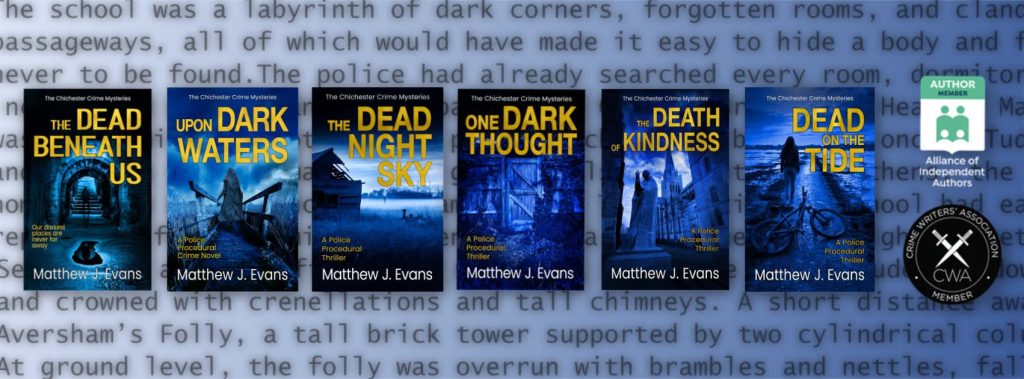
As most of you know, I’m primarily a crime author, drawing on nearly twenty years of policing experience to write novels set in and around Chichester and West Sussex. I enjoy writing police procedurals, developing mysteries, and creating characters whose lives become increasingly complicated as an investigation unfolds.
However, I’ve already ventured into slightly different territory with my DI Angelis series, which combines traditional police investigation with supernatural elements.
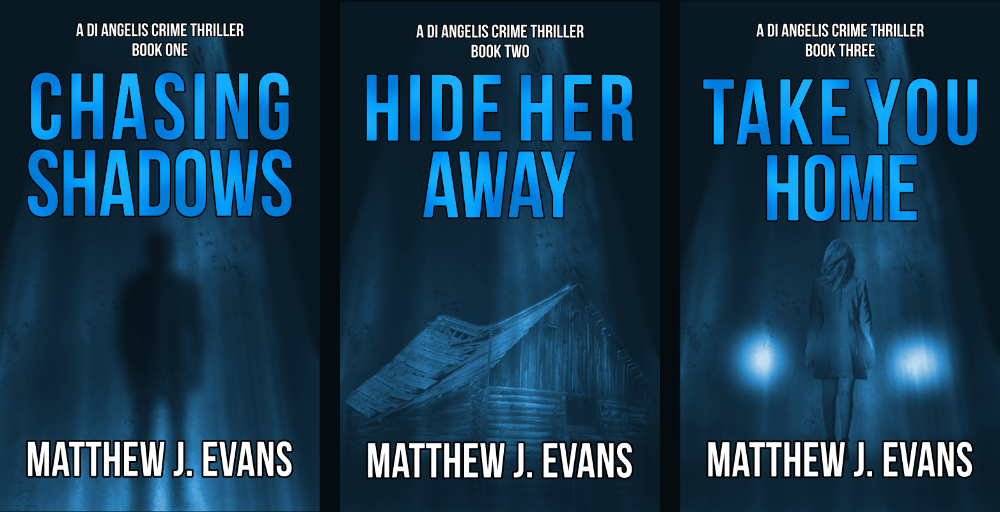
Those who have read both series will know that the DI Angelis books are quite different from The Chichester Crime Mysteries. I’ve sometimes thought the supernatural aspects of the Angelis stories are a little like Marmite. Some readers love them, while others prefer the more conventional police procedurals featuring DCI Beniamin Dinescu. And that’s perfectly understandable. We all have our individual tastes.
My interest in the supernatural and the fantastic goes back many years. Around the time I began writing fiction, I spent some time studying magical realism, a form of storytelling that has fascinated me ever since.
I’ve also enjoyed reading fantasy and other imaginative fiction by authors such as Stephen R. Lawhead, Frank E. Peretti, Paulo Coelho, C. S. Lewis, and, of course, J. R. R. Tolkien.
These writers have very different approaches to storytelling. Some create entirely imaginary worlds, while others bring extraordinary events into recognisable, everyday settings. I’ve found much to enjoy in both approaches.
More recently, one of my all-time favourite television series has been Small Prophets, created, written, and directed by Mackenzie Crook. It’s a wonderful example of how an ordinary, familiar setting can accommodate something decidedly strange. The story follows a lonely man whose life takes an unusual turn when he begins growing small, magical beings in his garden shed. I particularly enjoy the gentle humour and the way the extraordinary becomes part of the characters’ everyday lives. It’s the sort of imaginative storytelling that appeals to me enormously.
When authors explore other genres
Of course, an established author deciding to write in another genre can sometimes unsettle readers. After all, they’ve come to associate that writer with a particular kind of book, and understandably expect something similar when they pick up the next one.
Some authors deal with this by adopting a different pen name. Nora Roberts, for example, also writes as J. D. Robb, while J. K. Rowling writes as Robert Galbraith, allowing readers to distinguish between different kinds of stories. There are good reasons for doing this, particularly when an author’s new work is very different from what their existing readers have come to expect.
Nevertheless, I believe authors should feel free to explore whatever subjects and genres interest them. Writing is a creative occupation, and part of that creativity involves experimenting with new ideas, different characters, and unfamiliar territory.
Readers have that same freedom of choice. Some are happy to follow a favourite author into another genre, curious to see what they will produce. Others prefer to remain with the books and stories they already know they enjoy.
I fully appreciate that some of my readers would have little interest in a fantasy novel or a story involving magical realism. Equally, there may be others who would welcome something different. Exploring another genre might even introduce my writing to readers who have previously had little interest in crime fiction.
And, of course, there’s nothing to stop someone enjoying several different genres. I certainly do.
Looking towards the future
So, where does this leave me?
Well, I still have a great affection for crime fiction, especially the police procedural. It’s a genre I know well through experience and thoroughly enjoy writing. There are still many more DCI Dinescu stories to tell.
At the same time, my longstanding interest in magical realism and fantasy has never really gone away. I find myself increasingly drawn to the possibility of exploring some of these ideas in my own fiction. Whether that eventually leads to a novel involving magical realism, fantasy, or perhaps another story that crosses genres remains to be seen. It’s something I’m giving considerable thought to.
I wanted to share this with you because I value the people who read my books, and I think it’s good for readers to know a little about the wider interests of the authors they follow.
Whatever I eventually decide to write, I hope there will always be readers who enjoy coming along for the journey.
Fantasy, Fantastic Fiction, and Magical Realism
For anyone interested in understanding these genres, I’ve included a table below explaining some of the differences between fantasy fiction, fantastic fiction, and magical realism. Although these categories sometimes overlap, each approaches the extraordinary in a slightly different way.
| Feature | Fantasy fiction | Fantastic fiction | Magical realism (magic realism) |
| Central idea | A world or situation in which magic and supernatural forces are real parts of the story. | An apparently supernatural occurrence creates uncertainty about whether it is real or has a natural explanation. | An otherwise recognisable world contains extraordinary events presented as part of ordinary reality. |
| Setting | Often an invented world; can also be our world with an established magical dimension. | Usually a recognisable, realistic world disturbed by something strange. | A recognisable social, historical or everyday world. |
| Treatment of the supernatural | Accepted as genuine within the story’s rules. | Its reality remains open to doubt, sometimes to the end. | Narrated matter-of-factly, with little demand for explanation. |
| Reader’s main question | How does the magic work, and what will the characters do with it? | Did something supernatural really happen? | What does the extraordinary reveal about ordinary life, history or belief? |
| Typical emphasis | Quest, conflict, wonder, mythology and invented systems of magic. | Ambiguity, unease, perception and competing explanations. | Family, community, history, memory and the mingling of everyday and marvellous. |
| Book examples | The Lord of the Rings — J. R. R. Tolkien A Wizard of Earthsea — Ursula K. Le Guin | The Turn of the Screw — Henry James The Sandman — E. T. A. Hoffmann | One Hundred Years of Solitude — Gabriel García Márquez Beloved — Toni Morrison |
| In one sentence | The magic is real. | The magic might be real. | The magic is treated as ordinary. |
Terminology note
Tzvetan Todorov (1939–2017) was one of the most influential literary theorists in establishing a definition of Fantastic Fiction. His central contribution was the idea that the fantastic exists in the uncertainty between a natural and a supernatural explanation of events.
“Fantastic fiction” here means the literary fantastic in Tzvetan Todorov’s narrower critical sense. In everyday publishing, “fantastic fiction” can also be a broad umbrella for fantasy, horror and other speculative writing. These categories can overlap, and interpretations of individual books may differ.
Useful Sources
Boydell & Brewer, A Companion to Magical Realism, hosted on Cambridge Core. Includes a discussion of Todorov’s literary fantastic.
A Companion to Magical Realism
Texas A&M University, Marvels and Wonders: Reading, Researching, and Writing about Science Fiction and Fantasy, section 5.1, ‘Introduction to the Fantastic’.