

How much money do you make from your books?
This question might be of interest to those looking into self-publishing, and the answer is simple. Let’s examine a typical book I sell on Amazon. These prices are accurate as of the time this post was published. Most of my books are between 82,000 and 85,000 words in length. I typically sell my later series books at around £2.99 for Kindle or £9.99 for paperback. On a Kindle book, I receive 70% royalties, minus a delivery price of about 5 pence. Therefore, I earn £2.06 per Kindle book. The Amazon paperback printing cost is £4.19 for an 82,000-word, 334-page book. I charge £9.99 and get a 60% royalty rate, leaving me with £1.80 per paperback book. My Kindle books are exclusively with Amazon as they are available on Kindle Unlimited. I get paid a varying amount per page read by readers on this scheme. On average, I earn roughly 90 pence per book read on Kindle Unlimited.

Can I find your books in a bookshop?
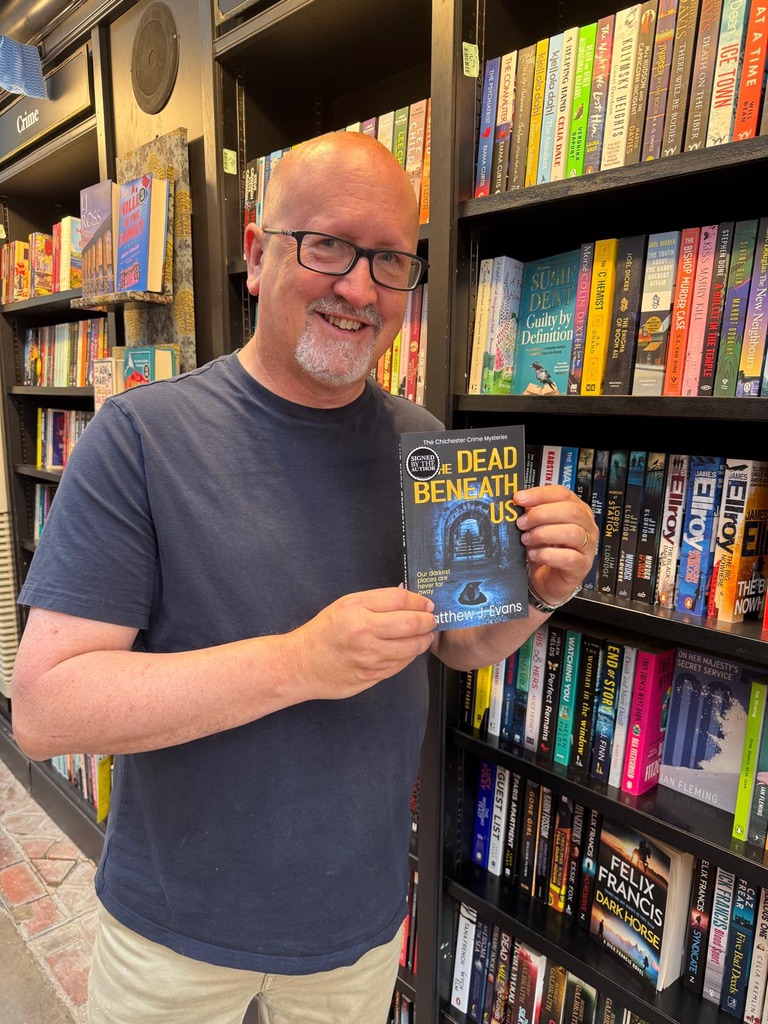
The answer to this used to be ‘not yet, but hopefully soon’. The answer is now yes! My print books are now available to order from most good bookshops (and libraries!), as well as Amazon and IngramSpark.
Ebooks and audiobooks are available from Amazon only, and Audible.
Where do you get your ideas from?
That old chestnut—Answer from the Author would not be complete without it. I’m not absolutely sure, but I know some of the clues to the answer. Where I live has something to do with it. West Sussex is beautiful. I love the Sussex Downs, the woodland, the coastline. It’s full of inspiration for locations.
My experience as a police officer must play a large part in it, but I was never a detective. I was the plod, serving in Portsmouth as a beat officer, then in Chichester city centre and on Response—that’s going to 999 calls. That experience gives me a very good understanding of police procedure and some insights into police methods.
Life experiences probably have the most sway on my writing. That encompasses everything, from my early childhood to my family life now, my work life as a software engineer, my experiences as a musician, and being a dad to three children, one of whom has a severe learning disability and autism.
Another source of ideas we should never forget is what we’ve read. I don’t mean plagiarising other people’s stories; I mean working with how some plots and characters made you feel. Most people remember a good book by how it made them feel. You can’t possibly consider being a writer if you don’t read fiction.
Ideas come to me in the form of images, impressions and feelings. Something could make me sad or angry—injustice is good at that. Things that make me laugh. Other sources of ideas are people I know or have met—their defining characteristics. Lastly, stories are there to entertain, to offer escapism. I don’t write parables, but sometimes, I like to leave people with a sense of hope if I can. Preaching turns people off, but highlighting a noble feature in someone’s character could inspire someone.
What books do you read?
I like a good thriller and some crime fiction too. For many years, I hardly read anything apart from technical books. I had read J. R. R. Tolkien, C. S. Lewis, and John Wyndham in my youth, but that was about it. It wasn’t until my wife started her degree in English and Creative Writing that I read more, listening to her experiences with other authors.
I enjoy a wide range of writing styles, from Lee Child to Cara Hunter and Agatha Christie. I also enjoy local authors like Elly Griffiths, Greg Mosse, and Graham Bartlett. I like C. L. Taylor, Ann Cleeves, Ian Rankin, Nicola Williams, and Jacqueline Harrett—so, so many. I’m about to pick up some Roman mysteries by Fiona Forsyth and others by Jacquie Rogers.
Will you continue the DI Angelis series?
This answer may not be popular with Angelis fans. Probably not, unless I get a lot of interest. I left the door open for him in case that happens. The DI Angelis series was my first foray into writing. He taught me a great deal about what people like and don’t like. To be honest, I think people who are avid crime fiction lovers were confused by the supernatural aspects of the plot, and those who love supernatural stories were confused by the police procedural elements. The books were a challenge to classify into a particular genre. As I said, I’ve learned a great deal since then.
Importantly, the DI Angelis series has now been released in a second edition, with some structural and editing improvements.
Plotting or ‘Pantsing’?
Those who read my books know that I’m a stickler for detail. The forensics and the procedure have to be right, although balanced in a way that keeps the story entertaining. How do I do this? I’m often asked whether I plot everything to the finest detail or fly by the seat of my pants—make it up as I go along.
The answer is something of both, and to be honest, all authors work differently. Don’t let anyone tell you this is how it MUST be done.
For me, I must know about the crime. Who did what, where, when, why, and how? I need timings, too. This is vital because when my characters start speaking, they must follow the story’s timeline. I also need to know the human story behind the crime. It’s not just because they’re nasty. There’s always a journey that leads someone to take someone else’s life.
When I know that, I describe the first scene. Location matters a lot to me, as you know. After that, I let the detectives follow standard methods for investigating a crime. The rules are preservation of life first (often too late in my books), then preserve and seize evidence.
The detectives’ stories just happen as I write. They will often say something that surprises me and shapes the rest of their story. I try not to bring in too much personal detail, but character is really important to me. Living characters have to grow and develop over time. Readers tell me that’s what makes them like the stories so much.
Woke or Realistic?
I’ve sometimes been criticised for being woke—for having such diverse characters. My first answer is: so what? It’s my story. Second, it’s my lived experience as a police officer. I’ve worked in diverse teams. It’s how it is.
How Real?
Another question I get is: how realistic is what I write? These books are not College of Policing Manuals. They are written to entertain, not inform. They are largely correct, but I must balance realism with moving a story forward. Also, the banter in a real police station is much darker at times. If you’ve seen some of the things police officers have seen, you know why. It gets them through the day.
Why a Romanian Detective?
I often get this question when I meet readers. The truthful answer is I have no idea. Well, I have a slight idea. DCI Beniamin Dinsecu came from not wanting to recreate the TV-trope detective: the drunk maverick, going through a divorce, cantankerous, unshaven, and smelly-looking! No. I wanted a detective who was a family man, intelligent, followed investigative procedure, and was a good manager who sought the betterment of those in his team. Boring? I don’t think so. He has had a fair share of trauma, literally scarring him physically and emotionally. He has a daughter with a complex physical disability. So, he’s not boring. But how he became a Romanian, brought up during the oppressive Ceaușescu era, just happened one day. My imagination went somewhere and came back with it.
What is next?
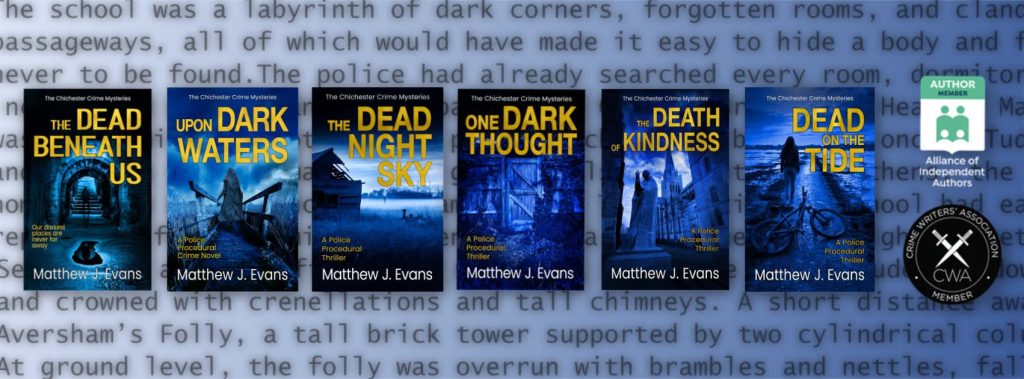
I am now going to continue writing the Chichester Crime Mysteries series, and hopefully develop those characters. I am always developing story ideas for DCI Dinescu and DS Emily Summers. I have other ideas for writing projects, and if I do write something in a different genre, then I will definitely use a pen name. Perhaps I should hold a competition to create a new pen name.
I’m going to write until I drop. It’s something I love, and it’s good for my mental health too. I want to increase my email list and develop a relationship with those who read my books. I feel that is important. I love reading people’s reactions to the stories and plot twists.
Lastly, I’m going to compose and record some more meditative music. It has a strong connection with my faith, and I find it helps to restore my balance.
That’s it for Answers
Thanks for all the questions I receive. I hope I’ve answered your question. If you have more for me, contact me. I’m always happy to receive emails.
Waterstones in Chichester
Article amended: 4th November, 2026