

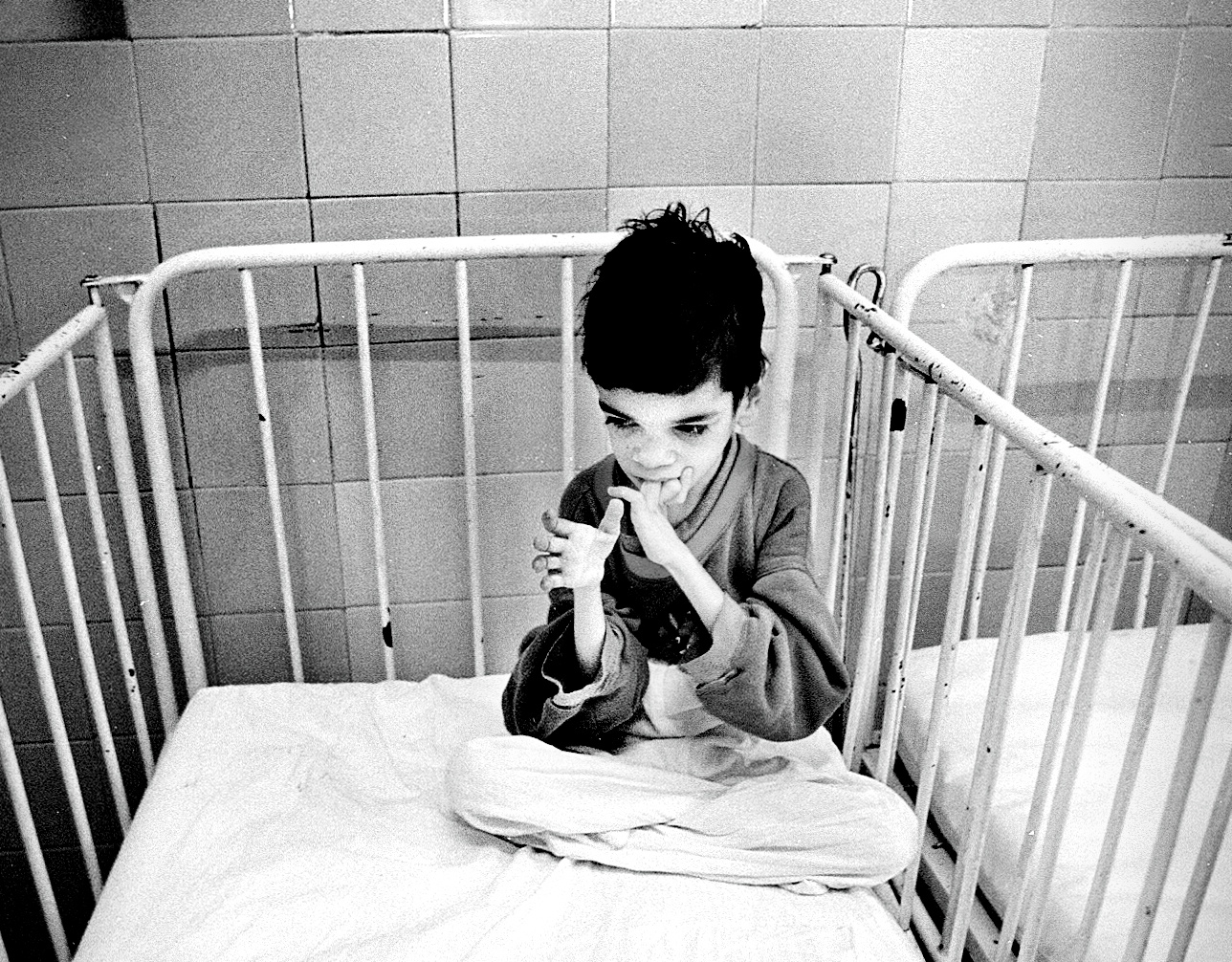
In the Chichester Crime Mysteries, DCI Beniamin Dinescu, the main protagonist, was one of the children rescued from an orphanage in Bacău, Romania, in 1990. At nine years old, he was taken in by foster parents and moved to London. They insisted that young Beniamin maintain his connection with his Romanian heritage and culture by introducing him to a Romanian community in London. Dinescu’s story is purely fictional, but quite deliberately, I didn’t want to create a fictional detective trope. I wanted to create a believable background for him that mirrors the real-life stories of many Romanian orphans, who faced years of psychological and physical hardship before finding safety and family support within Romania and abroad. This article gives some background to Romania’s Orphanages under Nicolae Ceaușescu.
History of Ceaușescu’s Orphanages
Romanian orphanages became notorious after the fall of communism in 1989. Many of us remember the shocking images of malnourished, neglected children being reported on the news all over the world. These orphanages were a grim legacy of Romania’s last communist leader, Nicolae Ceaușescu, and his pro-natalist policies. In 1966, Ceaușescu prohibited abortion and contraception for most women, believing that creating a larger population would bring about economic growth. Tragically, as a result, many thousands of children were born to families too poor to care for them and were abandoned to state institutions. By 1990, over 100,000 children were living in these Dickensian-style orphanages, often in appalling conditions. He had either failed to foresee the consequences of his decree, or he had failed to respond to the crisis that ensued.
As was clear from the news reports, children in these institutions had faced severe neglect. Many were malnourished and lacked adequate medical care or close human contact. The lack of nurturing, including the basic need for human love, had caused severe developmental delays. As they grew older, many were misdiagnosed with mental or physical disabilities and were confined or sedated. Ceaușescu’s regime chose to prioritise cutting costs, treating these children as a burden on society, which led to further abuse and deprivation.
Following Ceaușescu’s downfall and execution on 25th December 1989, several international organisations responded to the crisis, working to rescue children from these institutions. Groups like Human Rights Watch, Hope and Homes for Children, and various charities played key roles in raising awareness, providing aid, and promoting adoption. Their efforts helped many children find homes, particularly in Western Europe and North America.
Damaged Children
Children who left Romanian orphanages often faced long-term psychological challenges, particularly attachment disorders and emotional dysregulation, as a result of their early neglect. Research shows that the lack of consistent caregiving, social interaction, and stimulation during critical developmental periods led to issues such as reactive attachment disorder (RAD) and post-traumatic stress disorder (PTSD). Many children struggled to form secure relationships, exhibited anxiety, and had difficulty regulating their emotions. Studies like the Bucharest Early Intervention Project revealed that early trauma and neglect could lead to impaired brain development, further compounding cognitive and emotional difficulties. While adoption into nurturing environments helped some children recover, many continued to face mental health challenges well into adulthood, requiring ongoing support and therapy to mitigate the impact of their institutional upbringing.
Romania’s Orphanages Today
Romania has changed greatly since the early 1990s. The old system of large-scale institutional care has been reduced, and there has been a long effort to move children into foster care, family-based care, smaller homes, or support arrangements that keep families together where possible.
The work is not finished, but the progress has been significant. Hope and Homes for Children says it has worked in Romania since 1998 and is working with the Romanian Government to close the remaining orphanages by 2026. Its current figures state that 643 children remain in orphanages across Romania, with 32 institutions still to close.
That is a huge change from the position after the fall of Ceaușescu, when more than 100,000 children were reported to be living in institutions.
For me, this history gives Dinescu’s fictional life a truthful foundation. His background reflects something that happened to many real children. Some were adopted abroad, and others remained in Romania. Some recovered, and others continue to struggle. Many carry memories that cannot easily be explained to people who have never lived through anything like it.
Dinescu’s past is not the whole of him, but it is an important part of him. His foster parents hoped he would one day return to Romania and find his mother. Their plan to integrate him into the Romanian community in London made sure Beniamin would not lose his cultural roots or his language. However, as so often happens in real life, things don’t always go to plan… not for my fictional detective, anyway. He now looms ever present in my mind, ready for more thrilling adventures.
Further reading
For readers interested in the real history behind this part of Dinescu’s fictional background, the following sources are useful:
- Human Rights Watch: Romania’s Orphans: A Legacy of Repression
- Hope and Homes for Children: Romania programme
- King’s College London: The English and Romanian Adoptee Project
- King’s College London: Romanian orphans landmark study tracks mental health 27 years later
- Nuffield Foundation: English and Romanian Adoptee study
Cropped image by Thomas Black57, Public domain, via Wikimedia Commons
Post updated May, 2026